

Navigating difficult family relationships and unresolved conflict

Christmas can bring up complicated feelings when you have a difficult relationship with your family. You might dread going home, feel anxious about seeing your parents or feel unsure whether to accept an invitation when things between you remain unresolved.
Perhaps there's been a falling out, a rupture in your relationship with a parent or sibling, or you've taken some time away because of ongoing difficulties. You might feel torn between missing your family, hoping things will finally be different and knowing that spending time together could mean returning to dynamics you've worked hard to recognise and move away from.
It can be difficult when you start seeing your family differently, but they still expect you to relate to them in the same way you always have.
Things you once brushed under the carpet, laughed off or accepted as normal might no longer feel acceptable. You might find it harder to keep the peace or pretend everything is fine, even when your family expect you to carry on as usual. At the same time, part of you might desperately wish you could unsee it all and hope that this year things will finally change and your parents will be who you have always needed.
If you've spent much of your life adapting to family dynamics, it can be difficult to recognise what you actually want. You might worry about disappointing your family, struggle to say no or question your judgement when considering doing something differently.
Should I still spend Christmas with family when our relationship is strained?
I understand how hard it is to contemplate spending Christmas with family when there's been no acknowledgement of what has happened between you and no meaningful attempt to repair it. Perhaps you've experienced hurtful behaviour, had an argument or tried to raise something that was dismissed or minimised. Christmas can bring added pressure to resolve things, make amends or put difficulties behind you before you're ready but you’re not sure that you can yet, if at all. Maybe you feel anxious about seeing them again, are worried that if might feel awkward, or are scared of getting hurt again. All of which are very valid.
But it might not just be about one particular incident. Maybe you are starting to see years of family dysfunction that you are struggling to tolerate anymore. Maybe you are tired of being the target of cruel jokes, feeling overlooked or treated differently to a sibling, having to manage a parent’s drinking, being made to feel guilty or indebted for things you didn't ask for, having your boundaries ignored, treading on eggshellls to prevent arguments erupting, being expected to organise everything or keep everyone happy, being disappointed by their lack of interest in you or gifts that show no awareness of who you are as an adult or what you actually want or need.
Maybe you haven’t even be invited for Christmas at all and yet there is an unspoken assumption that you will go like you always do. Or maybe your family haven’t made any effort to engage with you at all since the rupture and are giving you the silent treatment. Perhaps you feel like you are being left to take all of the responsibility so you are not abandoned, or maybe you feel like you are being set up to make the decision so that they can act like the victim if you choose not to go.
It can feel like a game you don’t know the rules of and can’t win.
Before deciding to see family at Christmas, you might want to ask yourself:
Are you considering going because you genuinely want to, or because you feel obligated, guilty, pressured or fearful about what will happen if you don’t?
What are you hoping will happen if you spend Christmas with them? Is this realistic?
Has anything changed between you, or are you expected to overlook what happened and brush everything under the carpet? Would you be okay with that?
How might you feel during and after spending time together if nothing is acknowledged or addressed?
What do you need from your family to feel comfortable reconnecting with them?
What if I decide to spend Christmas with family but want things to be different?
Deciding to spend Christmas with family doesn't mean you have to fall back into the same family roles, routines or expectations. You might want to see your family but recognise that something needs to change in how you approach the day. That means focusing on what you can control and letting go of trying to control your parents’ behaviour to try and get them to be the parents that you need. This Christmas, may or may not be too soon, and getting support from a therapist who specialises in this area can help you to process your feelings and come to an acceptance so you have less of a need to get it from them.
Wanting an apology, acknowledgement of how you feel and changed behaviour is not asking for too much, but your parents or siblings might not have the emotional maturity or self-awareness to give it. It doesn’t mean you have to brush the family problems under the carpet either and forgive and forget, but instead you may feel able to celebrate Christmas together whilst not losing your own perspective and being able to hold onto your truth despite their attempts to control or manipulate.
Perhaps this means setting boundaries around how long you stay, what days you visit, not staying overnight, meeting in a neutral place or choosing what activities you're willing to participate in. You might decide not to avoid particular conversations, not react to criticism or get drawn into arguments, or tolerate jokes and comments at your expense. If staying for a longer period of time is unavoidable, maybe you can find ways to have regular breaks from each other, like going for a bath or walking to the shop, that gives excuses to have regular breaks from each other without drawing too much attention.
It might also be worth considering your exit plan so that if things do begin to feel diffcult you have a way out. For example, taking your car so you can leave whenever you want or arranging to see a friend as an excuse to leave earlier.
Setting boundaries can feel uncomfortable, particularly if your family isn't used to you doing things differently and you might experience guilt, resistance or pressure to control you and push you back into the familiar family role (eg the family scapegoat) but you don’t have to play it out (eg reacting to triggers with arguments that reinforce their perception of you as being the problem).
You don't have to choose between cutting contact and continuing to do everything as you've always done. There may be ways to stay connected while making more room for your own needs, limits and wellbeing.
Deciding not to spend Christmas with family and/or going low or no contact
Maybe you have tried changing the boundaries and reducing how much time you spend together over Christmas but continue to question whether contact is right for you and still find it too harmful when you see each other. Maybe it is too hard to try and accept how they see you and that the family dynamics won’t change because they need you to be the problem.
If you've grown up with a narcissistic, alcoholic, critical or emotionally unavailable parent, then Christmas can bring up familiar difficulties at an amplified level. Perhaps your parent expects everything to revolve around their needs, becomes critical when things don't go their way, drink too much and ruins everything or makes you feel guilty for making different plans.
If you've spent much of your life adapting to these dynamics, it can be difficult to recognise what you actually want. It's worth remembering that feeling guilty doesn't automatically mean you've done something wrong. Sometimes guilt is connected to going against expectations you've learned to live by, rather than doing something that conflicts with your values and can be a way for family members to manipulate you into not seperating with your own opninions and needs.
You can understand why a relationship is difficult and still feel attached to the person. You can recognise that their behaviour has hurt you and still miss them. These feelings can exist alongside one another.
Whatever you decide, it doesn’t necessarily mean you are closing the door on future Christmases together. You can make a decision based on what feels right for you now, not what family expect from you or what society says Christmas is ‘supposed’ to look like. Consider what feels manageable, what you need and what you're ready for right now. Choosing not to spend Christmas together this year doesn't mean you can't reconsider in the future.
Should I break no contact with my family for Christmas?
If you've needed some space recently, have chosen to go low contact or been estranged from your family for a while, Christmas can bring up questions about whether to reach out, respond to an invitation or give your family another opportunity to reconnect. You might miss certain family members, feel sad about not having the Christmas you wish you could have or worry about what other people will think. But you don’t have to “forgive and forget”. You get to decide what is right for you.
Before deciding whether to re-establish contact, it can help to consider what has actually changed in the relationship:
Has there been any acknowledgement of what led to the conflict or estrangement?
Have previous attempts to resolve things resulted in any meaningful change, or apology?
Are you looking back with rose tinted glasses and romanticising the good moments instead of remembering the pain, criticism, neglect or disappointment?
Would you be expected to take all the responsibility, repeat the same harmful patterns or play out the same role in the family?
What would the emotional costs be to you if you were to go back?
Do you genuinely want to try a different kind of relationship or are you struggling with guilt, grief or loneliness?
There isn't one right answer. Some people decide to reconnect, others maintain their boundaries, and some explore a different level of contact with particular family members. You don't have to make a decision simply because it's Christmas.
Get support with difficult family relationships
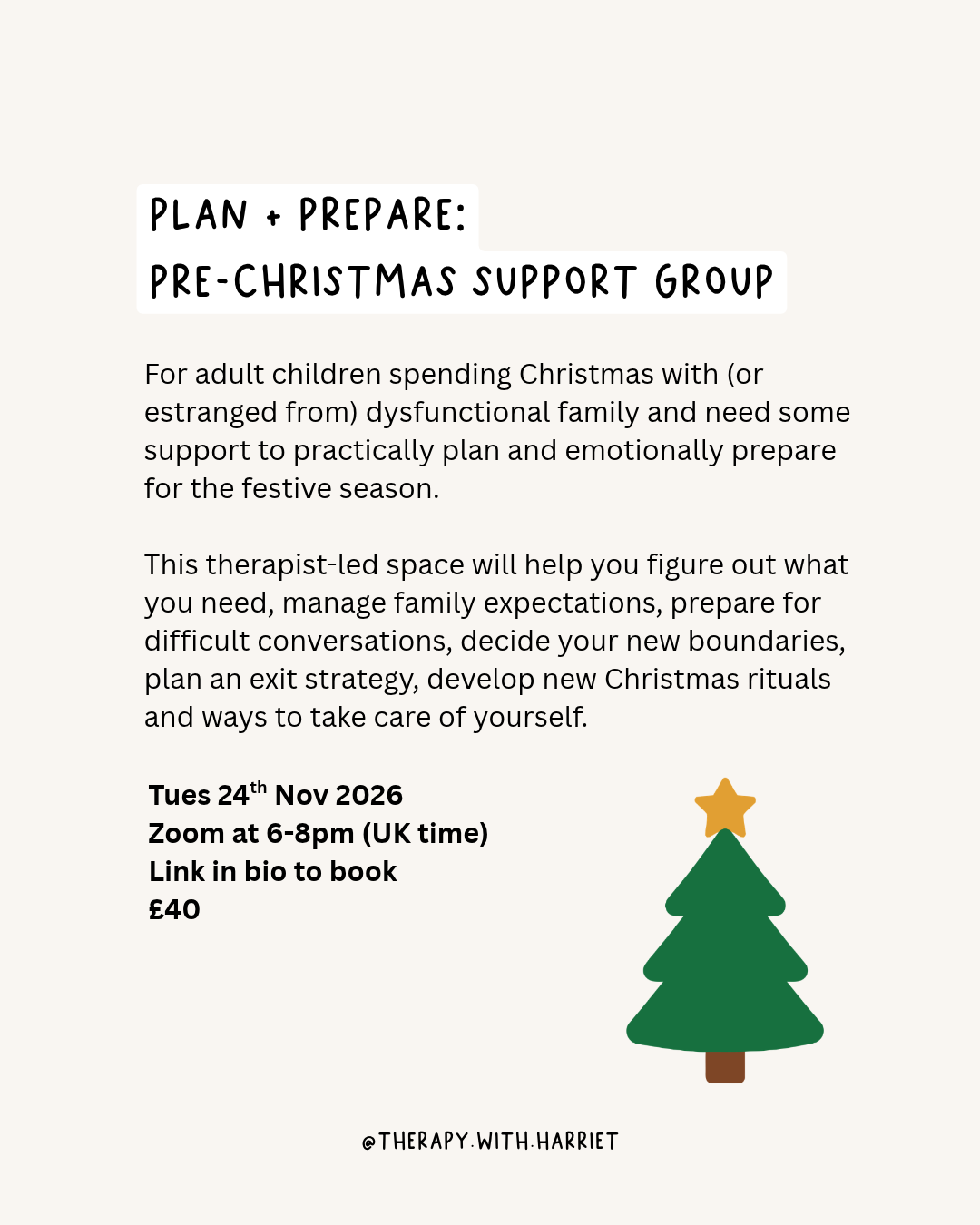
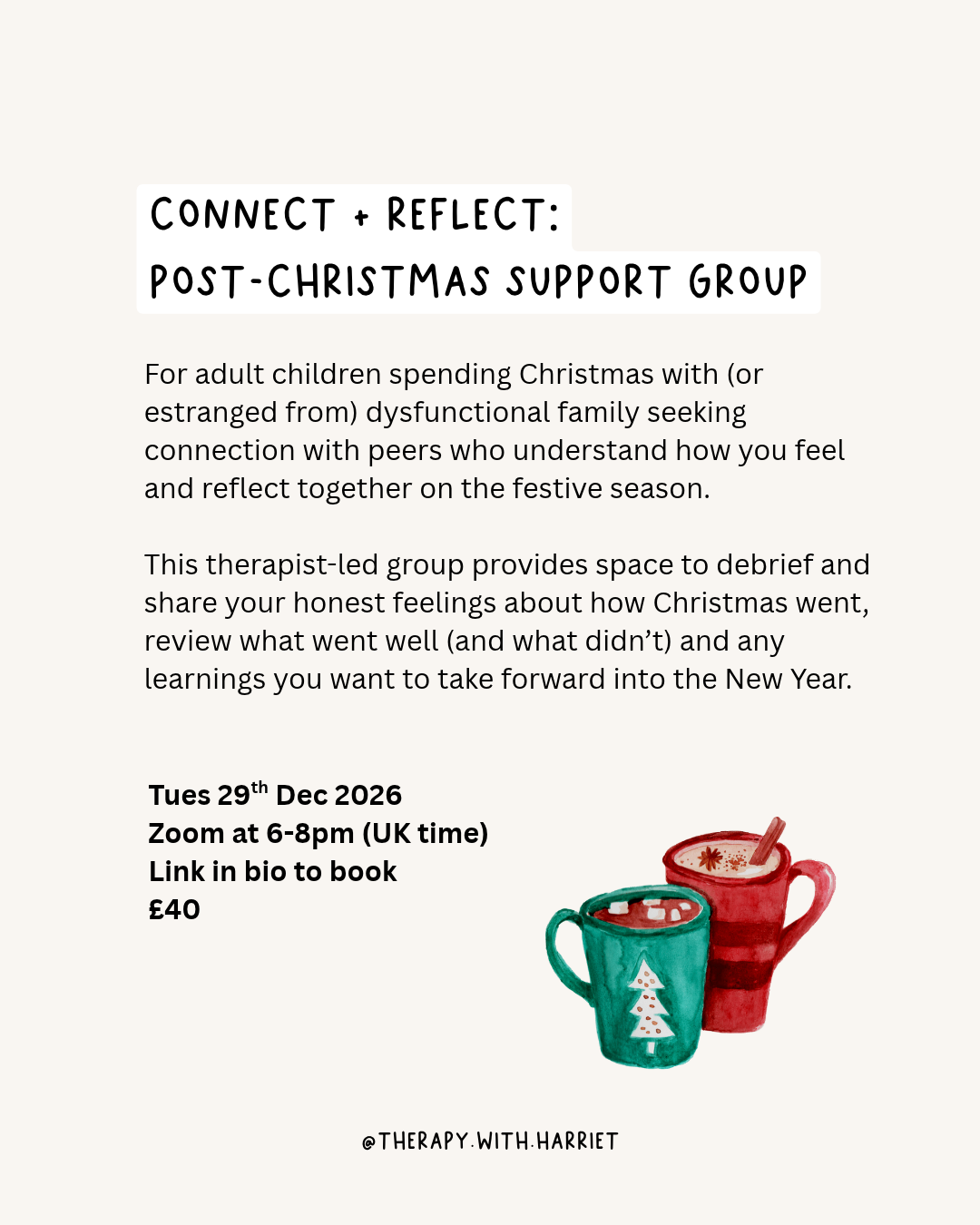
Join my online Christmas support groups for adult children with dysfunctional family members for practical and emotional support over the festive period:
Alternatively, start online individual therapy for personalised, in depth support to help you recognise and heal from relational patterns from childhood.
Harriet specialises in supporting adult children of narcissistic, alcoholic or emotionally immature parents to heal from attachment wounds, improve self-esteem, navigate low contact or estrangement and practice new patterns of relating in other relationships.
Online sessions available to book with no waiting list on Tues, Weds or Thurs from the convenience of your own home.
Click here to drop Harriet an email and arrange a free 20 min Zoom call to see if we might be a good fit.
